


October 5, 2025
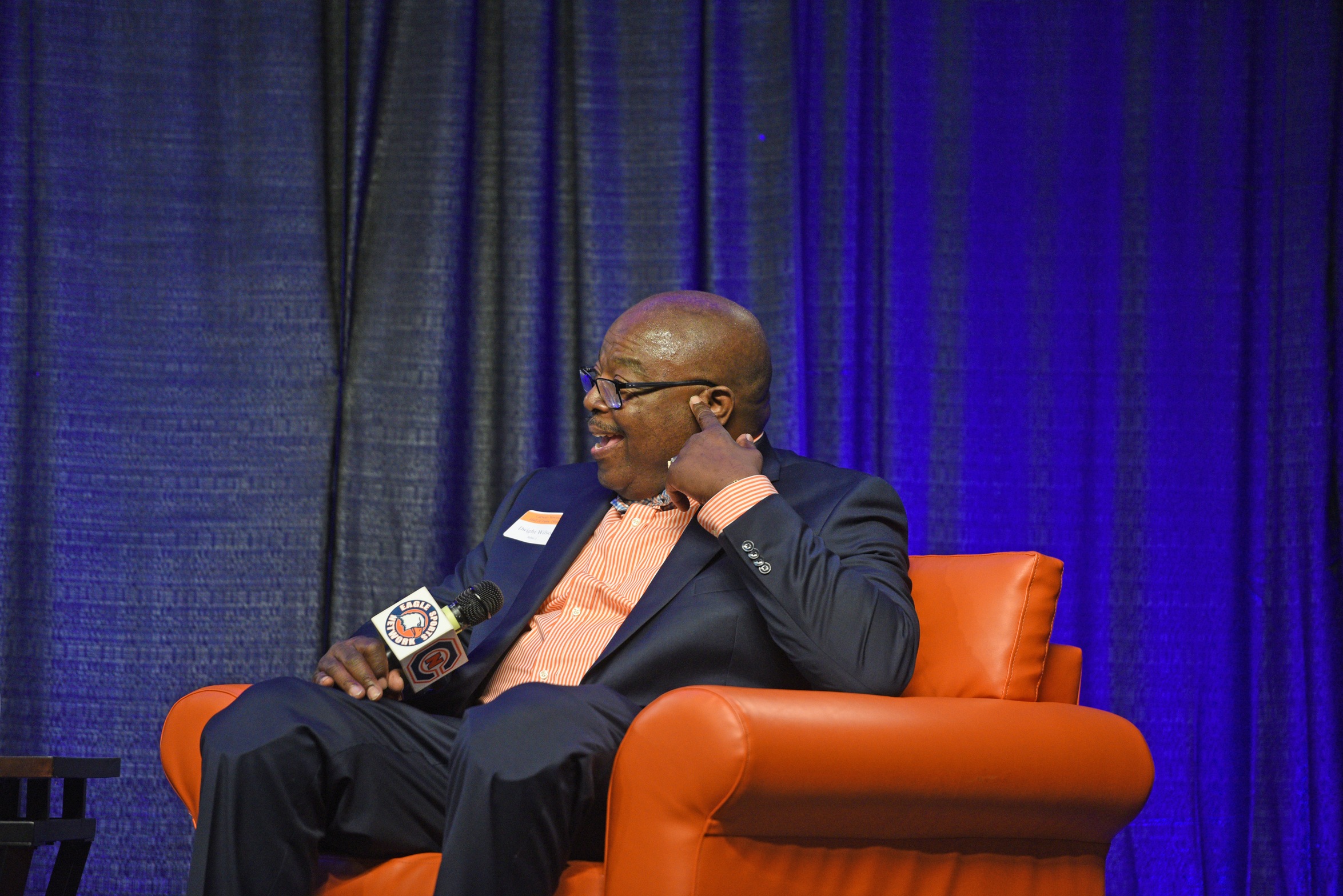
From Wendy's to the Carson-Newman Hall of Fame - The Dwight Wilson Story
Dwight Wilson was at a crossroads.
Dwight Wilson was at a crossroads. He had finished his sophomore season at the University of Tennessee as offensive guard, but right before the summer break his father passed away, and Wilson struggling to deal with it.
"I had never faced a death of anyone close to me," Wilson said at the Carson-Newman Hall of Fame banquet during his induction. "The love of the game left me. I decided I didn't really want to play anymore"
With the work it takes to be an elite athlete requiring dedication that Wilson no longer felt compelled to do, he moved on. He had decided that he would be a restaurant manager for the Wendy's Hamburgers franchise and that is where then Carson-Newman offensive coordinator and future head coach Mike Turner found him.
"One evening, it was probably 8-9 o'clock at night, four or five guys came into the restaurant and one of them was a little chubby redheaded guy and he says to me, 'Are you Dwight Wilson?'" Wilson said. "I said, 'Yeah, what can I do for you?' He said, 'I want you to come to Carson-Newman and play football. That's how it all started. Coach Turner recruited me at Wendy's Restaurant."
What came from that chance encounter was a new path for Wilson, one that led him to the banks of Mossy Creek where he would become the Eagles' first All-American offensive lineman and was a key reason the team claimed the 1983 NAIA National Championship.
It wasn't an instant decision. Wilson, after meeting with Turner and his fellow C-N coaches at Wendy's that night made his way home for Christmas. He was still considering returning to the University of Tennessee, then coached by Johnny Majors, and had set up a meeting with his former coach in January. But on the way home Wilson felt something on his heart and stopped at a phone booth to call Coach Ken Sparks at Carson-Newman.
"Coach Sparks answered the phone, and I said, 'Coach, I think I'm coming to Carson-Newman,' and he said, 'Well, all right, brother.' And you know, I told my buddies, I said, this guy is really cool, he called me brother.'" Wilson said. "…I was in some parking lot, and he was like, all right, brother, all right, brother, and so he had Butch meet me and brought me to campus, and that's how we got started. …It felt right. To this day, I don't know why I made that phone call."
That brotherhood impacted Wilson from the first day he arrived at C-N. In one of his first meetings with Coach Sparks, the coaches and the rest of the team, Wilson met men that would become lifelong friends.
"I still remember our first team meeting, when I got here in 82, and you had the likes of James Coffer, Terry Minor, and all those guys, Jeff Joslin, and you know, we had our first team meeting, and Boone was just a comical, crazy guy, laughed loud and everything, and Coach Sparks …was talking about what it meant to be an Eagle, and letting us know how you can't soar like a night owl, and be an eagle, and you know, he was a little confident that, you know, night owls can hoot, they hoot, they hoot, but the eagles, they fly, they soar, and James Coffer just sat there, and he thought it was the funniest thing in the world, listening to Coach Sparks compare us to owls versus eagles. You can't stay up late and out late like an owl and be an eagle.
"But I enjoyed everything, learned a lot, met a lot of good people, good teammates, and even, like I said, we were all on the same level. We didn't put anybody down because they weren't a starter, but everybody was needed to make that team work, and we had some great players."
Many of those teammates attended Wilson's Hall of Fame induction back in April. The men that played with him and coached him have remained fixtures in his life.
"They have meant the world to me," Wilson said. "And I guess the most beautiful thing about it, you know, we sweated together. We worked together. We hurt together. We cried together, but we all became brothers. And of course, those are relationships that'll never end. And I'm happy today to have a whole lot of those relationships. I mean, (Scott) McClanahan, Chuck King, Brad Spivey, Rick Oler, Jimmy Covington. And it's just, when you see each other, it's a beautiful thing. I remember when I was working, occasionally, they'd come by my job, four or five of them, and we'd just sit around and we'd laugh forever until I had to run them out of this door so I could get back to work. But we had great, great times and great relationships. Even Coach Turner, he came by. He came by occasionally. And of course, Mark (Isom) came by occasionally. Ken Tyson, just a lot of those guys that are still in the area. We got to see each other a lot, and we still see and talk with each other.
"Rusty Cutshaw, you know, he's always telling everybody as well, I didn't get to play, of course, because I played behind a guy named Dwight Wilson. Just a lot of jokes, a lot of laughter, but genuine love for one another. Genuine love."
It's moments and lifelong relationships like that Wilson recalls and wonders if players today could experience a journey like his, with all the NIL money and year-round constant recruiting of players already on college teams. Wilson could see himself in today's landscape and how differently his life might have turned out.
"He's probably not coming to Carson-Newman anymore with NILs, the way the transfer portal is, which is to some degrees a shame because of the opportunities that a school like Carson-Newman can provide just from a transformative growth standpoint," Wilson said. "So selfishly, I want there to be more Dwight Wilson transformational stories, but just the way that college athletics is, it feels like less and less. I couldn't see it happening unless the right things fall in place."
The lessons Wilson learned at Carson-Newman, under Coaches Sparks and Turner and the rest of the staff resonate with him today. The brotherhood, what it takes to create a championship team and not only be successful on the football field but be successful in life.
"I mean, just a lot of good stuff," Wilson said. "Stuff that you'll take with you forever. You'll never forget. And a lot of it was trying to do everything the right way. You know, regardless of who you were, regardless of what you accounted for, but this was a team. We were all one team. And we all made one. You make a mistake, you miss this, miss that, you might find yourself running after practice, just like the guy that didn't even show up for practice the day before. So, he (Sparks) didn't show favoritism, but he wanted everybody to know that we're all together, one to make one."
And that team, together as brothers, accomplished incredible things. But in those accomplishments, it's single moments that stick out in Wilson's memory. Like the moment where it seemed hopeless in a game, facing a third and very long situation. But Kenneth Tyson was his running back and he had Wilson and the rest of the "big uglies" in front of him. It was the perfect marriage between a skill player and the men in the trenches.
"It was a third-and-22, and they're running a 22-dime, and I look at Coach Turner like, are you crazy?" Wilson said. "And we pick up a first down. But they go hand-in-hand, but no doubt, they appreciate each other. And one can't be successful without the other. But you know, and the great thing about it, in Ken Tyson, he was just a superior hard runner."
Memories from his national championship game stick with him too, a 36-28 win over Mesa State. Wilson's physicality, that would lead him to multiple All-South Atlantic Conference selections, two All-American nods and a short stint with the Cleveland Browns in the NFL, was on display.
"I still remember the first play against Mesa in the National Championship game," Wilson said. "And of course, you know, the first time you hit a guy, you want to make him think about it. And I hit this linebacker, and he said, you don't have to go so hard, man. You don't have to go so hard. And I'm like,' you're kidding me.' So, after that, every time I got a chance to lay the boom on this guy, I mean, I had him running before the game was over. But it's just amazing. And of course, I didn't realize maybe what kind of player I was, but you know, I love the game. And that's just, that was the only way I knew to play."
It was toughness and on-the-field violence that Mike Turner helped Wilson hone and develop over his time at Mossy Creek. It was the only way Wilson knew how to play. So that's how Turner played him.
"When you needed to be pushed, he (Turner) pushed you," Wilson said. "When you needed a pat on the back, he gave you a pat on the back. But overall, he showed you what you needed to do. If you wanted to be successful, but even more important than that, he showed you how to do it. By example or by encouragement. …But just a great guy, great guy. And we still have a great relationship to this day. Even with my family, my kids and my wife, we all love him."
It's been a while since Wilson was a road grader for the Eagles veer attack. His health issues have been many and cost him both his legs. But the lessons he learned at Carson-Newman, from Coach Sparks, Turner and the rest of the staff, remain with him to this day. Men who, at the time, weren't much older than the players they coached.
"Even now you don't realize how close in age you were with those guys," Wilson said. "But yet, they were able to instill the greatness in you by teaching you good, everyday rules. Why are you doing certain things, what are you doing for? Are you doing it because you like it or because you want to get better?
"In this game of football, you know when it's time to go. You know when the clock is ticking and the scoreboard is not where we want it to be. You never want to leave anything on the field. You want to give all you've got while you've got the chance to give it."


